- WWDC 2026
- I, IP, IPO...
I'm doing only two stories this week because each story has multiple angles and even still I can't begin to cover all of them in great detail.
WWDC 2026
I took the unusual move of watching the keynote stream along with three recording devices: Plaud Note, iFlytek AINOTE 2, and TCL Note A1 NXTPAPER. I had them all record the audio of the entire keynote as I watched it and then had each of them transcribe and summarize what was recorded. As usual from my previous experiences in comparing such results, Plaud had the most robust summary, but I found it interesting that each device took a slightly different approach and therefore had different areas of focus in their summaries. The AINOTE 2 treated it as a big team meeting and summarized what each of the speakers discussed. The TCL tablet gave brief summaries of each major topic consisting of 3 or 4 bullet points. Only Plaud gave me an infographic:
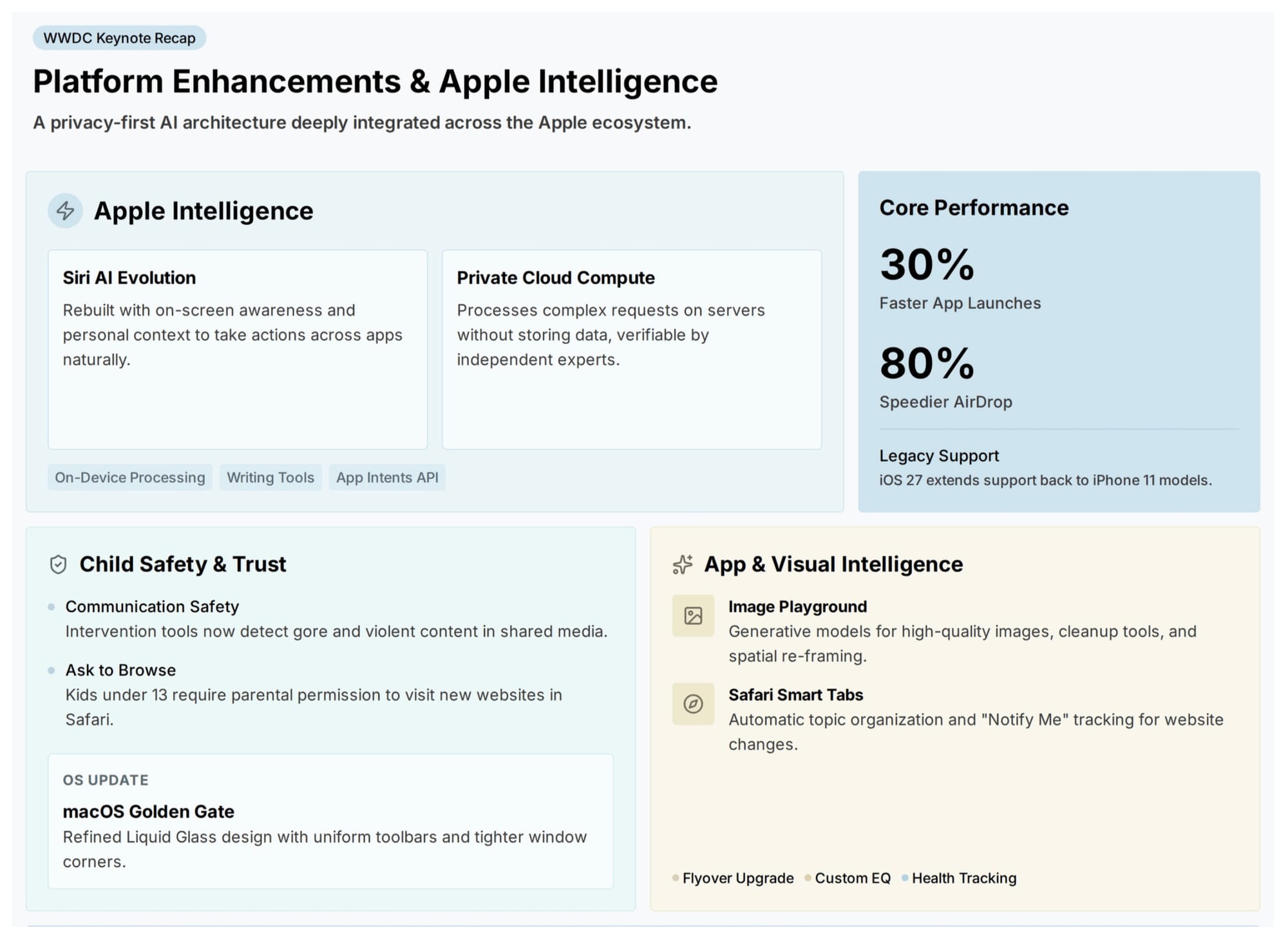
Note - this is not an ad for Plaud. I realize I sometimes sound like I'm a Plaud influencer or something, but I truly like the product enough that I paid for two years of service in advance. I use it at least once a week and sometimes multiple times a week. I probably should check to see if they have some kind of referral or influencer program, though. I'm right up their alley.
The summaries all agree that there were at least three main areas of discussion - platform improvements, parental controls and child safety, and Apple Intelligence updates.
Much has been made on many a website of the atypical format of this year's keynote. Apple usually goes through its various operating systems and outlines the changes to each. Because I am not a person that pays close attention to the structure of Apple's yearly WWDC keynotes, this didn't strike me as particularly strange. What struck me as strange was the difficulty I had just paying attention to the keynote, period. Normally even if I'm not terribly interested in a topic (for example, almost anything concerning the Mac since I'm not a Mac user and don't currently have plans to buy a Mac), I can still appreciate what updates they are making or at the very least, appreciate the aesthetic prettiness of whatever it is they are presenting. Apple's videos are always lovely to watch and this can usually keep me engaged. But I had a hard time focusing this year. Wait, what did she say about improved WiFi performance? Oh well, good thing I am recording this. I found myself in that type of cycle throughout the keynote. I am not a design snob so the loving attention paid to symmetrically rounded corners and the ability to tailor Liquid Glass opacity was nearly completely lost on me. I don't think I've thought one moment about Liquid Glass on my iPad since I first got the update that included it. It hasn't gotten in my way, so maybe that's a compliment of sorts. And while I appreciate all the potential performance updates on the various platforms, I learned in Home Economics in high school that any time anyone says "up to" that should set off red flags to be aware of marketing-speech coming at me. I do trust Apple's claims a bit more than most technology companies, but what does it really mean to say apps launch up to 30% faster? Will I even notice? And while transfers via AirDrop are something I use more now that I can take advantage of it with my Samsung and Google phones, I still don't do a lot of cross-platform transfers using AirDrop and it's not often that I am transferring files where I'm sitting there counting the seconds. I would still just prefer if file management on the iPad wasn't still extraordinarily frustrating despite the significant improvements of the past few years.
Of the various improvements that stuck with me the most are the supposed enhancements to the intelligence around WiFi, the addition of perimenopause tracking in Apple Health, and the ability to employ equalization settings for AirPods. I sit and watch my husband tell Siri to turn off WiFi every single time we get into the car together and each time it irritates me that he won't just create an Apple shortcut to do it for him automatically. And although I am the target demographic for perimenopause tracking, I find that this is an area that isn't well supported by most fitness platforms. Most of the apps that do period tracking are all still happy to tell me that my period is coming in X number of days, as if I was still 25 and as regular as clockwork. The truth is neither me nor the fitness app has any idea when my period is coming and we should both just be honest with ourselves about that. I am interested to see how effective and helpful this feature will be. And as for EQ for AirPods, I have to admit this is something I never expected Apple to do. I have AirPods Pro 2 that I use with my iPad Pro, but I knew when I bought them that I would be accepting how they sound unless I tweaked them inside some app like Apple Music or Spotify. And the truth is, as an audio snob and borderline audiophile, I don't use my iPad and AirPods for critical listening. That is why I have high-res audio products that I use with my Android devices and digital audio players with headphone jacks so I can use wired headphones when I really want to hear all the detail. Yet, even though I would be inclined to try this feature and did in fact go into settings to try it out once I installed the developer beta, I can’t take advantage of it unless I buy the new AirPods Pro 3. I am less inclined to spend money to try out this feature, but I do hope more people will be able to get more out of their (latest) AirPods now.
I know countless outlets have made much of the details around the newly improved Siri and its ability to finally do many of the things that Apple showed us two years ago. But although I don't have young children, I was nevertheless pleased to see all the updates Apple unveiled to help parents better manage their children's digital lives. Android has had some level of parental control, and more importantly offers the ability to have multiple accounts on a device - something Apple still smugly refuses to do since they know you will just cave and buy another iPad, even if used or refurbished. And even if some of these improvements were made to stave off negative attention from the likes of the EU and USA governments, the changes are still thoughtful and well-considered. I like the expansion of the Ask to Browse and Ask to Buy features and the ability to control what people are allowed to send messages to your children is also very welcome. If I did have small children, I could see these features being immediately useful and instantly deployed on their accounts. Right now there is some tension in my mind about handing a child a tablet of any kind and worrying about how they will doubtless find ways around the safeguards you've tried to put in place. No system is foolproof, but Apple has closed some big holes here, especially with browsers. And let's face it, even if all these features existed on Android tablets, how many parents would have bought their kids Android tablets just to take advantage of them? If the parents have an iPhone, the kid is most likely getting an iPad of some type. So it's great that Apple is putting more effort into this area, no matter how late they may be.
Nevertheless, I do think that Siri AI is important for Apple as it reboots its attempts to launch into the AI stratosphere. I also agree with many pundits who have said that Siri AI does not need to be the best in order for Apple to "win". Although the world is much bigger than the United States where I live, the iPhone is still dominant in this market and having more people feeling comfortable enough to ask their phone to do things for them means that more people will be comfortable enough with AI that perhaps some of the backlash against the technology can fade to quieter background noise as people find some value in its capabilities beyond asking it about the weather or querying about possible diseases one may have based on symptoms. No other AI assistant will have access to iPhones and iPads like Siri will, so all other AI assistants could become non-starters for many once they have good experiences with it. Apple could therefore win in the consumer AI market without even really having nearly as robust a product as its competitors. Its ubiquity will weigh more than its utility.
I, IP, IPO
To be honest, I do not care about the SpaceX, Anthropic, or OpenAI initial public offerings that have been filed in the past few weeks. What is more interesting is the bit of frenzy that has surrounded them. I'm not against any of these companies per se; I might have some concerns or even biases against some of their leaders, but I'm not antagonistic toward the companies or the products they offer. Now, I do not think that Grok is a good product and I do believe that Elon should be ashamed of it, and perhaps he is based on some of the statements he made in his testimony in his trial against OpenAI last month. But I do think that we need continued space exploration and if the government is no longer willing to spearhead it, then I guess companies like SpaceX and Blue Origin are one way for billionaires to put their money toward possibly useful endeavors. SpaceX and Starlink do have real value as companies and Starlink would likely be profitable on its own. But Anthropic and OpenAI's products are solid and can offer real value to people who know how to use them. AI isn't going anywhere and these are three of the biggest companies pushing the industry forward. If a bubble is ever going to pop, no one can seem to predict when, so in the meantime, some people will make a lot of money and hopefully some positive advancements can come from continued research and development.
There are many aspects of the explosion of artificial intelligence into more facets of our lives that trouble me. I'm a writer and many writers are concerned about the value of their writing being diminished over time as more people begin to consider the output of chatbots sufficient. I'm also a musician and songwriter, and there is much angst among musicians about music being used for training AI tools to make music that mimics the sound they took years to hone and craft. And like writing, music is an industry where you can work really hard and make almost no money and also seemingly work nearly not at all and make tons of it. Trying to get regular people to see the value of paying for the thing you birthed from your heart, mind, and soul can be tricky, especially for people who don't have a lot of money to spend. We may prefer art created by humans for humans, but sometimes a (free) reasonable facsimile will do. How do artists combat this wave? Some artists choose to use AI as a tool to help them refine their art or to just generate more of it more quickly. Some choose to try to fight and raise awareness of what is happening, hoping to be part of the conscience of the industry and advance the changes they want to see. But there is a tidal wave here that is washing up against all artists. Knowing how to swim won't save us. We need to find a way to harness the waves. The Coast Guard is not coming to our rescue.
Even if you're not an artistic person or even a person inclined to ever use a single AI tool for any purpose, the addition of these companies to the stock market will probably impact you in some way. Many have written about how index funds will own shares in these companies and your retirement and other investment accounts will probably own some of those index funds. How the market responds to the coming ebbs and flows of the AI industry remains to be seen, but so far nearly everything surrounding AI has been volatile. Perhaps more importantly, the influx of cash to these major AI companies means the ability for these companies to spend even more to refine and improve their technologies and products. AI has advanced swiftly in the past few years and continues to progress rapidly. More spend means that the improvements could accelerate and lead to improvements and changes we might not anticipate that could therefore impact our lives in ways we can't predict. If you look at the effects so far on not only the creative arts but also education, medicine, science, and even the military, you can begin to understand the scope of change that is possible over the next few years. We might not recognize the world we live in by then.
Member discussion: