- Affordable Windows Laptops Incoming?
- Exorbitantly Expensive Windows Laptops Incoming?
- Opal Camera Increases the Resolution
Affordable Windows Laptops Incoming?
No matter how you feel about Apple, there is no doubt that they often set trends and move markets. It seems that after the explosion of MacBook Neo, Qualcomm has finally awakened and realized people want Windows laptops that cost less than a thousand dollars. With their new Snapdragon C platform, Qualcomm is aiming not only at the MacBook Neo, but also at low-end Intel and AMD chips. Nearly anyone who has used computers with those chips has learned to aim their future aspirations in a higher and more performant direction. But those low-end chips were undoubtedly cheaper than their higher-end brethren. To bring prices down, Qualcomm is using ARM's Kryo architecture that is focused on efficiency and thermal management. These new Snapdragon C laptops will be fan-free, allowing them to operate quietly with longer battery life. These laptops aren't aimed at creators with heavy video editing workloads, but are designed for everyday uses like web browsing, reading email, and dinking around with your spreadsheets. They are in fact aimed at the same types of users that Apple is attempting to attract with the MacBook Neo. Yet these laptops will have some advanced capabilities as they will have a neural processing unit built right into them, which means they will be able to do some basic AI tasks like ensuring your webcam video looks its best or that noise is reduced from your microphones. However, these new laptops will not be eligible for Microsoft's Copilot PC branding because their neural processing units cannot produce the 45 TOPS (trillion operations per second) that's necessary for that badge. The first Snapdragon C Platform laptops are expected to have no more than 8 GB of RAM, which may be a limitation for Windows, but we'll see if Microsoft is able to supply any performance enhancements to make these laptops run more smoothly for everyday multitasking. Acer is one of the first to unveil its Snapdragon C laptop with the Aspire Go 15. It features a 15.6-inch 1080p display, up to 8GB of RAM, 512GB of storage, a 1080p webcam, a 53Wh battery, Wi-Fi 6E, and full-function USB-C ports. Other manufacturers are expected to unveil their Snapdragon C laptops later this year.
There is another avenue for low-cost Windows laptops as well: Dell unveiled its new XPS 13, using an Intel Wildcat/Panther platform instead of the new Qualcomm Snapdragon C platform. Where it appears that the new Qualcomm Snapdragon C laptops will be inexpensively made with potentially very plastic bodies, Dell is aiming for a more premium build to compete directly against the MacBook. The new XPS 13 will have a CNC-machined aluminum body that is 12.7mm thin with a backlit keyboard, which is a strike right against the MacBook Neo, which lacks this key (hah!) feature. The XPS 13 will also have a 2.5K touchscreen with a 120 Hz variable refresh rate. The XPS 13 will start at $699. Dell is obviously expecting that some people will appreciate its high-quality build and additional features and choose it over the MacBook. Dell will also build more expensive tiers of the XPS 13 to aim at users who are willing to pay for more power and performance. But Dell starting the revived line at a price that competes favorably with the MacBook Neo with a laptop that doesn't look like cheap trash is a great start.
Be we still really need Microsoft to fix the many issues and concerns people have with Windows in order for all of this to really take off.
Exorbitantly Expensive Windows Laptops Incoming?
If you somehow felt left out of the last conversation about cheap computers because you really want something with a lot more to offer, don't you worry, this next story is right here for you. Perhaps you always wanted a computer with the performance you could expect from a datacenter-class PC but also wanted the benefits of high-end graphics processing for your demanding GPU and CPU intensive workflows? The RTX Spark platform coming to us from NVIDIA and MediaTek is positioned to meet this unique niche. The new platform is a system-on-a-chip (SoC) featuring an NVIDIA 20-core Grace CPU, a Blackwell RTX GPU with 6,144 CUDA (Compute Unified Device Architecture) cores and fifth generation Tensor cores optimized for AI tasks. The chip-to-chip connection is ultra-high-bandwidth to reduce the latency introduced by typical motherboard design. Up to 128GB of unified memory will be available to allow for more local AI processing. In the previous story, I referred to the 45 TOPS performance benchmark for a Windows PC to branded as a CoPilot PC. No need for worry here as this platform can produce up to 1 PETAFLOP (i.e. 1000 TOPS or 1000 teraflops) of AI performance at a 4-bit floating point precision (FP4). This is enough to store an AI model with 120 billion parameters and have a context window with up to 1 million tokens. For context, the small model Gemini Flash 3.5 from Google is estimated to be anywhere from 8 billion to 30 billion parameters and Google's latest model intended for local AI processing, Gemma 4, comes in a 12 billion parameter version that can run on typical enterprise-issued laptops with only 16GB of RAM. It's not just for AI, though. At Computex, NVIDIA showed demos of a reference machine running 3D scenes in Blender that were 90GB or larger. Adobe announced that it is working on new versions of Photoshop and Premiere that will take advantage of this new hardware. The new laptops, while extremely powerful, are still expected to be thin and light as these are, after all, ARM machines. And to combat the typical problems consumers have had with ARM machines, Microsoft has stated that its X86 emulator has been updated to ensure compatibility with X86 games, even those with anti-cheat systems, and NVIDIA has confirmed that the new systems will support ray tracing, DLSS, and G-SYNC. These are all things that are very important to gamers who up until now have largely sidestepped ARM machines entirely due to the many compatibility issues.
Machines are expected in the fall, and a number of manufacturers are signed on, including Asus, Dell, HP, and Microsoft. Microsoft showed off its upcoming Surface Laptop Ultra featuring this SoC at Computex. These machines won't be cheap; with powerful NPU and GPUs plus a hefty amount of RAM, I would expect these machines to start at $3000 and go way up from there. But even if you never buy one of these machines, it is important for Microsoft to keep Windows in the game for high-end computing tasks, especially video-intensive tasks that have been ceded to Apple's high-end MacOS-based laptops and desktops. And for users who want to keep using Windows for gaming, it also means that these advancements will eventually lead to better and quieter gaming machines with ARM chips, which perhaps won't be a sad oxymoron in the near future.
Oh, and did I also mention we still need Microsoft to fix Windows? Yes, that - and not just for developers and enterprises.
Opal Camera Increases the Resolution
Opal Camera first came to fame with its $300 C1 4K webcam, marketed as something of an artisanal product crafted from anodized aluminum and offering high-quality video for demanding consumers and professionals who wanted to look their best on livestreams and video conference calls. But in reality, the C1 had some nagging issues. The autofocus wasn't the best and the camera worked better with MacOS than Windows (shocking, I know...). It was followed up with the Tadpole, another 4K camera designed to be small and packable for portability. Its design allowed it to be clipped onto the lid of a laptop as a replacement for the nearly universally terrible webcams stuffed into the average laptop ever since webcams in laptops became a thing we all had to endure. It was a more reliable webcam than the C1 and was more affordable at $130. But it didn't set the world on fire, either. I bet you don't know anyone who has either webcam unless they're a famous YouTuber. You could even carry the Tadpole around in a custom case to use as a very expensive and unnecessarily techy yo-yo.
Well, they're done with yo-yo webcams because they've got big money behind them now with OpenAI as a backer and a new mandate of becoming a technology company producing multiple products infused with AI, most notably OpenAI's flavor of AI as they've struggled to produce physical products despite proclamations of their imminent appearance. The new Opal Electronics will deliver premium products that they say will be aimed at the top 10% of tech enthusiasts - the golden decile, as they have deemed it - that expect the best in design and performance. Or something like that. We have no idea what their first products will be and who exactly will be their target market. It is theorized that they will make audio wearables for always-available recording, desktop tools similar to an Elgato Streamdeck, and screenless smart home speakers. The audio wearable is expected to be the first product, with a launch window as small as within a few months from now. With their past experience, it seems likely that future products will also incorporate cameras in some way as well. Opal Electronics has backing from not only OpenAI, but Peter Thiel, Alexis Ohanian's venture firm Seven Seven Six, and Marques Brownlee, known to many as the YouTuber MKBHD. It seems they should be able to go somewhere with all that behind them.
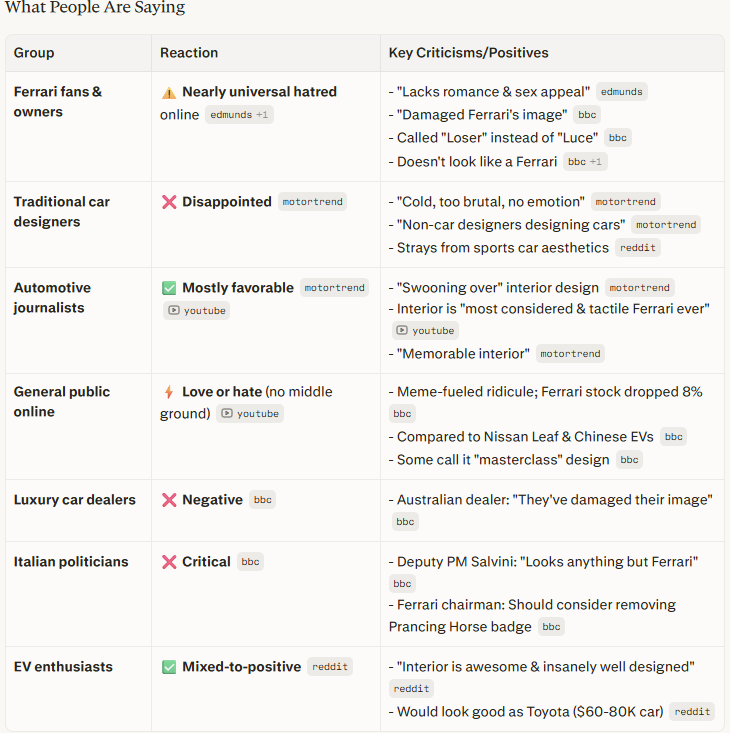
But then again, maybe not. Have you seen/heard all the buzz around former Apple designer Jony Ive's adventures in car making with the new Ferrari Luce? (see AI-generated chart below if you haven't...) Let's hope this Opal thing works out better than that.
Member discussion: