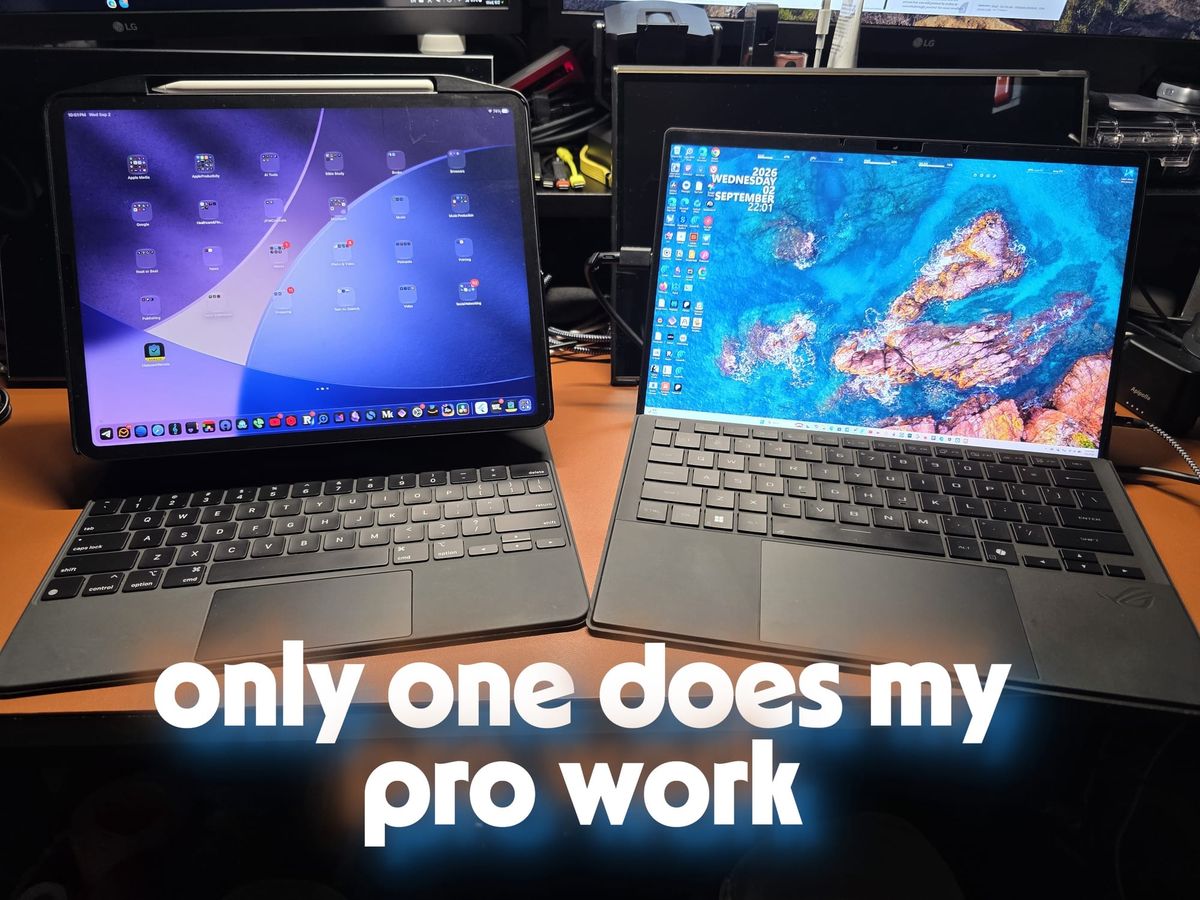
See link to my YouTube video at the bottom of this post!
The original iPad Pro was introduced on 9/9/2015 by Tim Cook and shown off in detail by Phil Schiller. This was the first appearance of the 12.9" screen, the introduction of pen support with the Apple Pencil, advanced accessory support with the Smart Connector system, and multi-tasking features including split-screen, slide over and picture-in-picture. The screen was as wide as the iPad Air 2 was tall, so you could run two apps side-by-side with an experience much like having two regular iPads next to each other. The screen had a variable refresh rate with 5.6M pixels, more than the MacBook Pro of its time. The iPad had admirable performance for its time; Apple claimed it was more powerful than 80% of the portable computing devices of its time in CPU tasks and 90% in GPU tasks. It offered 10-hour battery life, which Apple expressed as "all day". It came with iOS 9, which featured updated Notes and News apps and detailed transit data in the Apple Maps app. It started at $799 for the Wi-Fi 32GB model and $1079 for the Wi-Fi + LTE 128GB model. The Apple Pencil cost $99 and the new Smart Keyboard cost $169.
I had the original iPad and iPad 2 but gave up on the iPad after that and moved to Samsung tablets with stylus support. After the Note 8 was discontinued, Samsung abandoned pen support with the Tab S line until the Tab S3 and in that lull, I ventured back into iPad territory with the 10.5" iPad Pro 2.
At that stage, I could still consider the iPads Pro to be professional-grade devices in many ways. They had better hardware than standard iPads so they could support more demanding applications and heavier workloads in the kinds of apps professionals might use in their daily life. Apple seemed to lean way in on visual artists such as graphics designers, illustrators, digital artists, cartoonists, and photographers. I bought one for the same reason I'd bought the original iPad: it seemed to be good for musicians like me that managed a large collection of sheet music and chord charts and periodically used digital tools to make music. Apple's iPads had an undeniable lead in digital music production over the Android tablets of the time, and the market was full of apps and hardware for all manner of recording, arranging, performing, transcribing, and producing. It just felt like I needed one and the introduction of the Apple Pencil intrigued me because I'd been a digital stylus devotee for more than a decade at that time, so Samsung's loss was Apple's gain.
I diligently researched and installed apps for my various creative needs. I used ForScore and MusicNotes for sheet music, Symphony for transcription and Auria for recording. I installed all my readers and news apps and really tried to dig into the experience. I put my Bible apps on it and carted it back and forth to church every Sunday. I even tried to use it to help me at work even though basic apps like the Microsoft suite and other corporate-type apps were a vastly inferior experience to anything available on Windows. This lasted for about a year when I once again abandoned the iPad for the resurgence of pen support in Samsung's tablet with the advent of the Galaxy Tab S3 and the eventual arrival of the original Surface Pro with Wacom EMR stylus support - my preferred stylus technology.
I cannot explain to you simply why the iPad never clicked completely for me. Is it years of mouse-and-keyboard muscle memory? I’ve been using touchscreens since they were invented, but I grew up using the mouse and keyboard, so maybe even though I think I’m well-adapted to touchscreens, perhaps I’m not as adaptable as I believe myself to be? Even my beloved stylus is just a more precise extension of a mouse when you really get down to it. But touchscreens do make some things easier. It’s often a more direct route to just tap on a thing than to try to navigate your mouse pointer to it. And the apps on the iPad were beautiful and most of them were intuitive and easy to use. The operating system was familiar as I'd not only had the original iPads, but I'd also had experience with two generations of iPhone (which I also abandoned for Windows Mobile and Android). Somehow, I always felt constrained. I always felt like I was having to adjust to the tablet instead of it working for me. Maybe it was just the transition from a mouse-first experience to a touch-first experience, but I never had the same feeling with my Android tablets, despite many of them having constraints of their own. I was able to do much of my semi-professional music and corporate work on the iPad, but I never enjoyed it. Some people describe Apple as a walled garden where everything is beautiful and wondrous so you never pay any attention to the wall unless you should happen to hit your head on it. I never got to a place of enjoying the garden's beauty because I apparently lived right on the wall and hitting it over and over again eventually became too much for me.
I really never gave iPad much additional thought until Stage Manager made its appearance in iPadOS 16 in 2022. It looked like Apple had finally done it: they'd made an interface that made more sense to people like me who'd grown up using windowed operating systems. The idea of being able to have more than 2 or 3 apps on the screen in a world where Samsung DeX had already been at thing for years wasn't novel, but it was new to the iPad and I was intrigued enough to buy a fully loaded 12.9" M1 iPad Pro to make use of the new features. I enrolled in the beta and started using Stage Manager right away. But it didn't take me long to realize that while this iPad was undoubtedly more powerful and the apps had improved greatly over the years, Stage Manager did not fill the hole in the operating system I'd hoped it would fill. And I lamented the loss of the headphone jack because using it as a music production workstation would have been that much easier if it had remained. I would have also appreciated a second USB port to make certain workflows easier. If Apple compares the iPad to Windows computers, why not give it some of the same advantages those machines enjoy? My ASUS ROG Flow Z13 has a headphone jack, a full-sized USB port and two USB C ports. All I'm asking is for one additional USB C port (it doesn't even have to be Thunderbolt!) and a headphone jack so plugging in headphones, storage, and even advanced things like audio interfaces, MIDI controllers, and power banks to keep it all going wouldn't be such a chore. Why do I have to constantly think about workarounds to make the iPad efficient for me and the things I want to accomplish on it? If I'm paying $2,000 for an iPad that is supposed to help me in my professional efforts, I expect it to do so and get out of my way, not constantly trip me up with limitations.
I kept my M1 iPad Pro despite its failure to make life easier at work and with my creative ventures. The latest updates to iPadOS have made it even more desktop like and I welcome the enhancements, but they haven't fundamentally changed how I use the tablet. I bought a Magic Keyboard when Woot ran a sale on them and now the iPad is a glorified secondary YouTube machine (my Tab S11 Ultra with its giant AMOLED screen is my primary YT machine) and occasional typing tool. I keep it charged up so I can try out iPad software on it to compare to the same or similar software on Android and Windows so I can write about how, most likely, an app is better on iPadOS than it is on the other platforms. Yet that doesn't cause me to keep going back to the iPad. I use my Windows machine for most real work like research, writing, and video editing but sometimes I'll do those things on my Samsung tablet if the Windows machine isn't at hand, But I rarely use the iPad for anything other than YouTube, social media, and software comparisons.
If the iPad added back the headphone jack and an extra USB C port, I'd probably try to take it more seriously as a professional grade tool for the creative work I do. I might just get over the annoyance of trying to use DaVinci Resole on it, which is just different enough from using it on Windows that I'd prefer to just not deal with it. There are some great apps for the iPad that I'm reasonably sure will never make it over to Android and there are some apps that have made it over that really probably should have just stayed where they were.
But most likely, the iPad Pro will remain a device I use to test new apps and occasionally watch video and type up some articles from time to time. I don't think with the way it works right now that it could ever be my primary device, even just for my musical and audio/video activities. It doesn't 'just work' for me.
Check out the accompanying YouTube video!
Member discussion: